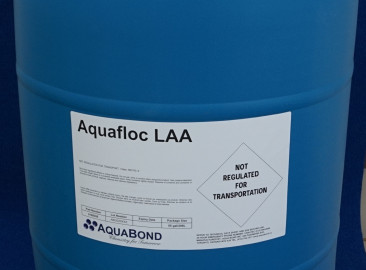
Aqua Floc

Aqua Bond provides Ultra-High Molecular Weight Inorganic Anionic Flocculant Polymer with superior sludge consolidation. Our water treatment taglines - "Two phases, One superior result." "Aqua PAC + Aqua Floc - the ABI advantage".  It is a white powder packaged in 25 kg Kraft paper bags with liner.  See TDS, SDS, ABI Water Treatment Program, and ABI Operator Training Program in the document section.
Unit Size/Capacity Availability Price Quantity
Bag (1 - 9 bags) 25 kg Only 1 Items in stock.
$350.00
Bag (10 - 39 bags) 25 kg Only 1 Items in stock.
$300.00
Bag (40 Plus bags) 25 kg Only 1 Items in stock.
$280.00

Aqua Floc — Ultra High‑MW PAM Flocculant for Advanced Water Treatment

Aqua Floc is a premium anionic flocculant engineered for demanding clarification and solids-separation applications where conventional flocculants cannot deliver the required settling speed, water clarity, or sludge performance.  When used with coagulants such as Aqua PAC or metal-specific adsorbents (e.g.bentonite systems: Aqua TriTreat), Aqua Floc forms very large, robust flocs that settle quickly and consolidate into low-volume sludge.  

Key Features
  • Ultra-high molecular weight polymer
  • Exceptional bridging capacity for fines and colloids
  • Strong synergy with all coagulants, especially Aqua PAC
  • Rapid formation of large, dense, drainable flocs
  • Improves sludge dryness and reduces disposal costs
  • Effective across municipal and industrial applications

How Aqua Floc Works
Aqua Floc uses ultra-long anionic polyacrylamide chains to bridge and bind microflocs formed during coagulation.  The result is strong, resilient macroflocs that settle rapidly, consolidate tightly, and dewater efficiently - even under demanding industrial conditions,
Applications
  • Municipal wastewater
  • Drinking water clarification
  • Industrial wastewater
  • Mining & Mineral processing
  • Food & beverage
  • Pulp & Paper
  • Oil & Gas/petrochemical
Benefits
  • Lower polymer consumption due to ultra-high MW efficiency
  • Higher solids capture and improve fines removal
  • Better belt-press, screw-press, and centrifuge performance
  • Reduced turbidity and suspended solids
  • Lower sludge hauling and disposal cost
Recommended Use
Aqua Floc is designed for use after coagulation with Aqua PAC.  Jar Testing is recommended to determine optimal dosage for each application.


Industry-Specific Aqua Floc Dosage Table (mg/L)

These are starting points - final values are determined by jar testing. 
Aqua Floc Recommended Dosage (mg/L)

 
Industry Typical Range Notes
Municipal Drinking Water 0.1 – 0.5 mg/L Very low dose; used only when additional floc strength is needed
Municipal Wastewater 1 – 5 mg/L Depends on sludge characteristics and solids concentration
Industrial Wastewater 2 – 10 mg/L Higher dose for emulsions, dyes, or complex organics
Food & Beverage 1 – 4 mg/L Works well with fats, oils, proteins
Mining / Mineral Processing 5 – 20 mg/L High solids; strong bridging required
Pulp & Paper 2 – 8 mg/L Excellent for fiber capture and fines removal
Oil & Gas / Petrochemical 3 – 12 mg/L Effective for oily solids and tank bottoms

Seven Industry Treatment Guidelines (Coagulation + Flocculation)

Each guideline includes the two-phase ABI water treatment method.
Municipal Drinking Water
  • Aqua PAC: 10 - 40 mg/L
  • Aqua Floc: 0.1 - 0.5 mg/L
  • Goal: Turbidity reduction, TOC removal
  • Notes: Aqua Floc used only when additional floc strength is needed for rapid settling.
Municipal Wastewater
  • Aqua PAC: 40-120 mg/L
  • Aqua Floc: 1 - 5 mg/L
  • Goal: Sludge thickening, improved dewatering
  • Notes: Aqua Floc dramatically increases cake dryness
Industrial Wastewater
  • Aqua PAC: 50 -150 mg/L
  • Aqua Floc: 2 - 10 mg/L
  • Goal: Removal of dyes, metals, emulsions
  • Notes:  Jar testing essential due to variable chemistry
Food & Beverage
  • Aqua PAC: 30 - 80 mg/L
  • Aqua Floc: 1 - 4 mg/L
  • Goal: Removal of fats, oils, proteins
  • Notes: Aqua Floc improves flotation and settling.
Mining & Mineral Processing
  • Aqua PAC: 60 -200 mg/L
  • Aqua Floc: 5 - 20 mg/L
  • Goal: Fines captures, tailings thickening
  • Notes: High solids require strong bridging.
Pulp & Paper
  • Aqua PAC: 40 - 100 mg/L
  • Aqua Floc:  2 - 8 mg/L
  • Goal: Fiber recovery, fines removal
  • Notes: Aqua Floc: improves press performance.
Oil & Gas/Petrochemical
  • Aqua PAC: 50 - 150 mg/L
  • Aqua Floc: 3 - 12 mg/L
  • Goal: Oily solids removal, tank bottom treatment
  • Notes: Aqua Floc enhances separation of oil-water-solids mixtures.
Aqua PAC + Aqua Floc Combined Treatment Philosophy This is the core of ABI's dual phase system or CEPT Program.  Essentially it is a Chemically Enhanced Primary Treatment system.
Phase 1 - Coagulation (Aqua PAC)
Aqua PAC destablizes colloids, neutralizes charge, and forms microfloc. This step is essential - without proper coagulation, flocculation cannot succeed.
Phase 2 - Flocculation (Aqua Floc)
Aqua Floc bridges microflocs into large, strong macroflocs that settle rapidly and dewater efficiently. This step transforms system performance.
Why the Two-Phase System Works
  • Coagulation handles chemistry
  • Flocculstion handles physics
  • Together they create a complete solids removal system
This dual-phase approach is used globally by  top water-treatment companies and now, a Canadian company ABI offers its own optimized Canadian version.
Summary
ABI's Dual-Phase Treatment system (CEPT) combines Aqua PAC and Aqua Floc to deliver unmatched water-treatment performance. Aqua PAC provides powerful coagulation, collapsing colloids and forming microfloc.  Aqua Floc then builds large, dense, drainable flocs that settle quickly and dewater efficiently. Together, they create a complete solids-removal solution that reduces turbidity, improves sludge dryness, and lowers operating costs across all industries. 
With industry-specific guidelines and AI-supported dosage recommendations, ABI gives operators a clear starting point - and jar testing ensures perfect optimization.  Aqua PAC and Aqua Floc work in harmony to deliver one of the strongest floc, the cleanest water, and the most efficient treatment process available today. Here is to stronger floc, cleaner water, and lower cost. Let's coagulate with confidence and flocculate with power.